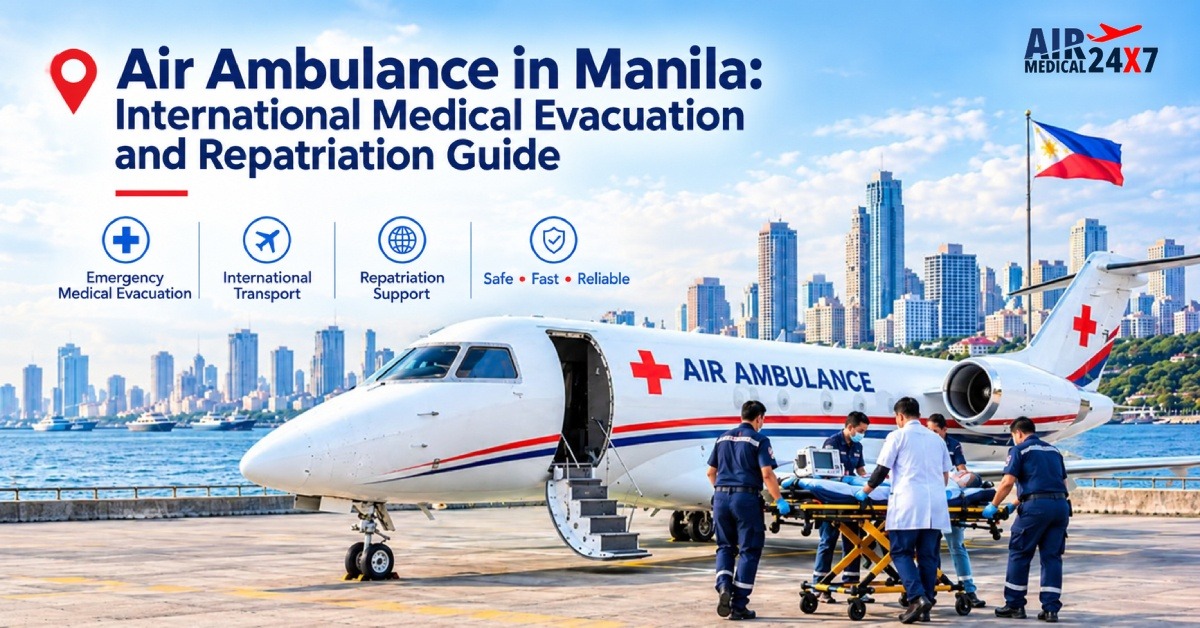
Air Ambulance in Manila: International Medical Evacuation and Repatriation Guide
Metro Manila is home to many of the Philippines' major tertiary hospitals and is served by major international airports, making it an important starting and destination point for international medical transfers. A tourist injured in a road accident, an expatriate who suffers a stroke, a Filipino patient referred abroad, a returning OFW who needs a bed near family: all of these pass through the same coordination steps.
What Does an Air Ambulance from Manila Involve?
An air ambulance transfer from Manila involves a medical assessment of the patient, coordination with the treating hospital, confirmation of the receiving hospital, and planning of the required ground and air transport arrangements. The patient is transported by a medically equipped aircraft with an appropriate medical team on board, with ground ambulance transfers arranged as required. Ninoy Aquino International Airport (NAIA) is a major departure point for international medical transfers from Metro Manila, although the appropriate airport depends on the patient's location, aircraft availability, and operational requirements.
Medical Evacuation or Medical Repatriation: Which Applies?
The two terms describe different purposes, and insurance policies may define and cover them differently.
Medical evacuation generally means moving a patient to another medical facility because the required level of care, treatment, or specialist services are not available at the current location. The transfer may be within the same country or across international borders.
Medical repatriation generally means returning a patient to their home country or another appropriate destination, often so they can continue treatment, rehabilitation, or recovery closer to their family and usual support network.
For example, a patient receiving appropriate care in a well-equipped hospital in Manila may not require evacuation on clinical grounds but may still require medical repatriation to return home safely.
When contacting an insurer or assistance provider, it is helpful to clearly explain whether the patient requires medical evacuation, medical repatriation, or another type of medical transfer, as coverage and approval requirements may differ depending on the policy and the patient's circumstances.
Who Arranges Transfers from Manila?
Usually some combination of the family, the treating hospital's coordination office, an employer, an insurer or its assistance company, and an embassy providing consular support. A medical transport provider handles the operational side with all of them. Where an insurer is paying, approval normally has to come before the flight is booked, and that approval is a common source of delay.
How the Transfer Works
- Case intake: patient details, current hospital, destination, and reason for transfer.
- Medical assessment: the medical team reviews the report and speaks to the treating doctor if needed.
- Receiving hospital: a bed and an accepting physician are confirmed, but if these are not arranged yet, we can also help.
- Transport recommendation, based on the patient's condition.
- Aircraft, crew, and clearances, where a dedicated aircraft is used.
- Ground transportation planning at both ends.
- Bedside pickup and transfer to the airport.
- Flight with continuous medical care.
- Handover at the receiving hospital or family member at the airport.
The sequence is covered in more detail in our step-by-step guide to arranging an emergency air ambulance.
Metro Manila Hospital to Airport: The Ground Leg
The ground transfer between the hospital and airport is an important part of an international medical transfer and requires careful planning. A hospital in Makati, Taguig, Quezon City, Pasig, or Manila may be relatively close to the airport geographically, but traffic and road conditions can significantly affect travel time.
Medical transport coordinators plan the ambulance departure time according to the patient's condition, expected traffic conditions, airport requirements, and scheduled flight time. Appropriate buffer time should be built into the plan, while the ambulance should have the medical equipment and personnel required to continue supporting the patient during the road transfer.
For patients located in Bulacan, Pampanga, or other areas of Central Luzon, Clark International Airport may sometimes be considered as an alternative to Ninoy Aquino International Airport (NAIA), depending on the patient's location, flight availability, aircraft requirements, and overall transport plan.
The airport should therefore be selected as part of the complete bed-to-bed transfer plan, rather than based only on the flight route.
Departure Airports: NAIA and Clark
NAIA is a major international gateway for medical transfers from Metro Manila. Clark International Airport in Pampanga is an alternative for patients north of Metro Manila or depending on flight availability and operational requirements. Which airport is used depends on the aircraft, permissions, and the patient's location. Airport usage and handling arrangements for Air Medical 24X7.
Transport Options from Manila
| Option | Typically considered for | Key constraint |
| Dedicated air ambulance | Patients requiring intensive monitoring, advanced medical support, or a level of care that is not suitable for standard commercial travel | Cost and aircraft availability |
| Airline stretcher with escort | Medically stable patients who are unable to travel seated and meet the airline's medical requirements | Airline medical clearance and seat availability |
| Medical escort on a commercial seat | Patients who are medically stable, able to travel seated, and meet the airline's requirements | Limited equipment on board |
Airline requirements are set by each carrier. Philippine Airlines requires a MEDIF completed by the attending physician and submitted five to seven days before travel, with the stretcher request made at least 48 hours ahead and an able-bodied escort accompanying the passenger. Our comparison of airline stretcher services and dedicated air ambulance transport sets out the trade-offs.
International Destinations and Routing
Medical transfers from Manila can be arranged to destinations across Southeast Asia, East Asia, India, the Middle East, Australia, Europe, and North America. Common destinations include Singapore, Kuala Lumpur, Bangkok, Hong Kong, Taipei, Seoul, Tokyo, major Indian cities, and destinations across the Middle East and Australia.
Routing depends on the patient's condition, aircraft range, flight availability, permissions, and airport requirements. Longer journeys may require a technical stop, while medically suitable patients may travel on commercial flights with an approved medical escort.
For more information, see our Philippines to India medical transfer guide.
Documents for an International Transfer
- Valid passport for the patient.
- Passport and visa for any accompanying relative.
- Entry requirements for the destination country, where applicable.
- Medical report and transfer summary from the Manila hospital.
- Fit-to-fly documentation, or the airline's MEDIF for commercial travel.
- Consent from the patient or next of kin.
- Insurance authorisation, where applicable.
- Settlement or guarantee of the hospital account before discharge.
Foreign nationals whose passports are lost or expired should contact their embassy in Manila early, since an emergency travel document takes time.
Inbound Repatriation to a Manila Hospital
The same process runs in reverse for patients coming home. The extra work sits on the Philippine side: choosing the receiving hospital, confirming the bed, arranging the ground ambulance at the arrival airport and, for OFWs, checking what support applies.
See our medical repatriation to the Philippines and medical repatriation for OFWs guides.
What Affects the Cost?
A quotation depends on origin and destination, distance and routing, the patient's condition and level of care, aircraft type, medical team, equipment and oxygen, ground ambulances at both ends, airport handling and permits, and urgency. Airline stretcher pricing follows the carrier's published fare rules and is charged separately from the escort's fare. Ask for an itemised quotation that covers both ends of the journey, not just the flight.
How Air Medical 24X7 Supports Manila Transfers?
Air Medical 24X7 coordinates international medical evacuation and repatriation for patients in Metro Manila, including medical assessment, hospital coordination, ground ambulance arrangements and bed-to-bed transfer. Aircraft, coverage and local partner details: [VERIFY WITH AIR MEDICAL 24X7].
7. FAQs
Which airport do medical flights use in Manila?
Ninoy Aquino International Airport handles most international medical flights from the capital region. Clark International Airport may also be used, depending on the patient's location, flight availability, and other requirements.
How long does it take to arrange an evacuation from Manila?
It depends on the medical assessment, receiving-hospital acceptance, documentation, and operational clearances. Airline stretcher cases need several days of lead time for medical clearance. Dedicated aircraft transfers are planned case by case.
Can a foreign patient be evacuated directly from a Manila hospital?
Yes, subject to medical assessment, documentation, and clearances. The transfer is planned from the hospital bed to the receiving hospital abroad.
Does an insurer have to approve the transfer first?
If an insurer is paying, prior approval is normally required. Contact the insurer's assistance line as early as possible.
Can relatives travel with the patient?
On commercial flights, relatives can usually book seats on the same flight, and airlines generally require an escort for stretcher passengers. On a dedicated aircraft, companion space depends on the configuration and the patient's condition.
What if the patient is not stable enough to fly?
The treating physician and the transport medical team may recommend continuing treatment until the patient's condition allows travel, or may plan a transfer with a higher level of on-board care.
 0
0
0
0
0 Comments
Leave a comment
Get a Quotation in 30 minutes
Categories
Recent Post
Plain Text
Air Medical 24X7 - Worldwide Air Ambulance and Medical Evacuation Services, delivering compassionate and patient-focused care every step of the journey.
Read More