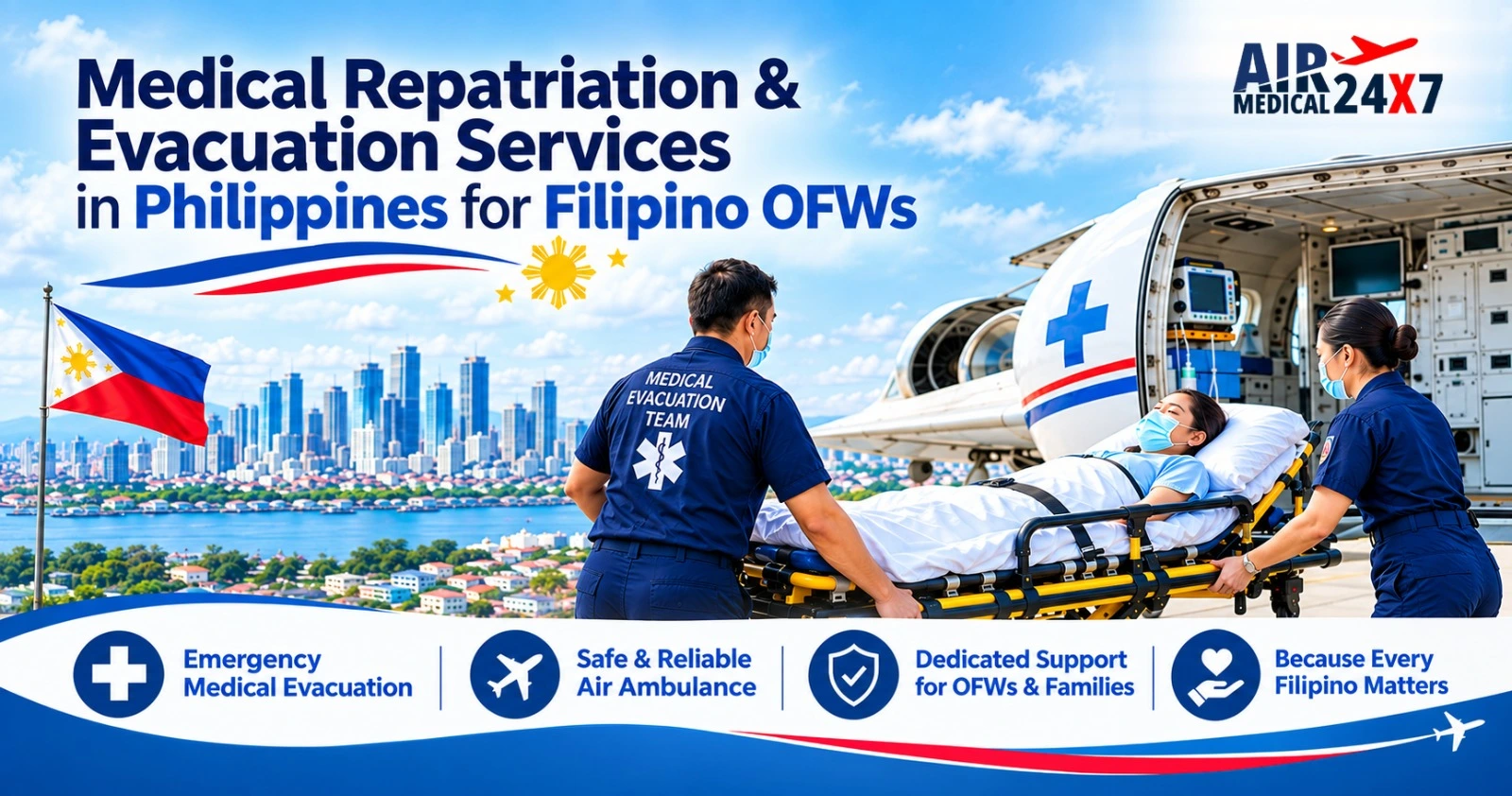
Medical Repatriation for OFWs: How to Bring a Sick or Injured Worker Home Safely
Most families hear about it in a phone call that gives them half the story. A brother collapsed at work in Riyadh. A husband was in a road accident in Dubai. The worker cannot simply book a ticket; the employer is slow to answer, and the hospital will only speak to certain people.
Medical repatriation Philippines is the process that gets that worker home safely. It involves a medical assessment, a choice of transport, coordination between two hospitals, and a set of documents completed in the right order. This guide explains each part so you know what to ask for.
What is Medical Repatriation for an OFW?
Medical repatriation for an OFW is the return of a sick or injured overseas Filipino worker to the Philippines with medical support during the journey. Depending on the patient's condition, this may be a medical escort on a commercial flight, an airline stretcher, or a dedicated air ambulance, with ground ambulance transfers at both ends.
When Does an OFW Need Medical Repatriation?
Repatriation is considered when a worker cannot travel as an ordinary passenger, or when continuing treatment abroad is no longer practical. Common situations include workplace injuries, sudden illness such as stroke or heart attack, conditions needing long rehabilitation, mental health crises that make unaccompanied travel unsafe, and chronic illness that ends employment.
Whether the worker travels now or later is a medical decision. A worker who is improving may be asked to wait a few days before flying.
Who Decides Whether the Worker Can Fly?
Several medical assessments may be involved, depending on the transport option. treating physician provides the current medical information and fitness-to-travel opinion; transport provider's medical team assesses the level of support required; airline medical department may separately review the case for commercial-flight clearance.
Commercial travel adds a third check. Airlines require a Medical Information Form, known as a MEDIF, completed by the attending physician, and their own medical team clears or declines the case. Philippine Airlines asks for the MEDIF five to seven days before travel for stretcher clearance, with the stretcher request made at least 48 hours ahead.
Fitness to fly depends on the individual patient and journey. There is no universal checklist. Our article on how doctors decide if a patient is fit to fly explains the factors.
What are the Transport Options?
| Option | Typically considered for | What it involves |
| Medical escort on a commercial seat | Patients who are medically stable, able to travel seated, and meet the airline's requirements. | A nurse or doctor travels with the worker on a scheduled flight. |
| Airline stretcher | Medically stable patients who are unable to travel seated and meet the airline's medical requirements. | A stretcher in the economy cabin, with an escort and airline medical clearance. |
| Dedicated air ambulance | Patients requiring intensive monitoring, advanced medical support, or a level of care that is not suitable for standard commercial travel. | A medically configured aircraft used only for that patient. |
See our comparison of airline stretcher services and dedicated air ambulance transport. Ground ambulance transfers can be arranged at the departure and arrival ends when required, allowing the patient to be transferred safely between the hospital, airport, and receiving facility.
How Does Hospital Coordination Work?
The transport provider's medical team asks the treating hospital for a current report covering the diagnosis, recent vital signs, level of consciousness, oxygen or ventilator requirements, current medications and infusions, recent laboratory and imaging results, and the treating physician's contact details.
At the same time, a receiving hospital in the Philippines reviews the case and confirms a bed and an accepting doctor. Families with a preferred hospital should say so early. The flight is not scheduled before that acceptance exists.
What Documents are Required?
- The worker's passport, which employers sometimes hold.
- Medical report and discharge or transfer summary.
- Fit-to-fly certification or MEDIF, depending on the option.
- Exit clearance or exit visa, where the host country requires one.
- Settlement or guarantee of the hospital bill abroad.
- Written acceptance from the receiving hospital.
- Authorisation signed by the worker or, if he cannot sign, the next of kin
If a passport has been lost, expired, or cannot be used, the Philippine Embassy or Consulate may be able to issue a travel document, subject to the applicable requirements.
What Support is Available from OWWA and the Agency?
According to OWWA, its repatriation program brings distressed and sick workers back to the country, with components including an air ticket, airport assistance, half-way home accommodation, medical assistance or referral, domestic transport assistance, and psycho-social counselling.
OWWA guidelines also address cost. Under Memorandum of Instructions No. 003, s. 1997, repatriation costs for a living OFW can include airfare, exit visa costs, penalties, travel expenses of escorts for medical repatriation, and other reasonable expenses, with OWWA seeking reimbursement from the agency or principal where they are responsible.
The assistance available in a specific case depends on the worker's circumstances, applicable government programs, employment arrangements, insurance coverage, and the requirements of the relevant authorities. Do not assume the employer, agency, or insurer will cover everything, and do not assume they will cover nothing. Ask each in writing.
OWWA regional offices also assist arriving workers. The Region XI office told the Philippine Information Agency that its airport teams are available around the clock, including for workers who are physically or mentally ill.
What Affects the Cost?
There is no fixed price. A quotation depends on the origin and destination, distance and routing, the worker's condition and level of care required, the transport option, aircraft type, medical team, equipment and oxygen, ground ambulance at both ends, airport handling and permits, and urgency.
Airline stretcher costs follow published fare rules. Philippine Airlines prices its domestic onboard stretcher between Manila and Cebu or Davao at 600 percent of the full one-way economy fare, with the escort paying a separate fare and an added charge if an oxygen tank is required. Other carriers and international routes differ.
Common Delays, and How to Avoid Them
Passports held by employers, unsettled hospital bills, no confirmed receiving hospital, incomplete medical reports, and late MEDIF submissions cause most of the lost time. Contact the agency, OWWA, and the transport provider in parallel rather than one after another.
How Air Medical 24X7 Supports OFW Repatriation
Air Medical 24X7 coordinates medical transportation for patients travelling to and from the Philippines, including medical escorts, airline stretcher arrangements, and dedicated air ambulance transfers. The medical team reviews each case before recommending an option, coordinates with the treating and receiving hospitals, and arranges ground ambulance transfers at both ends. Fleet, equipment, and coverage details: [VERIFY WITH AIR MEDICAL 24X7].
FAQs
How long does medical repatriation for an OFW take?
It depends on the medical assessment, document readiness, and the transport option. Airline stretcher cases need medical clearance in advance, so they are rarely arranged in a day. A dedicated air ambulance can usually be planned more quickly once documents and hospital acceptance are complete, though permits and aircraft availability still apply.
Who pays for the repatriation of a sick OFW?
It depends on the employment contract, the agency's obligations, any insurance in place, and the worker's OWWA membership. Costs are sometimes shared. Ask each party in writing.
Can a family member travel with the worker?
On commercial flights, relatives can usually book seats on the same flight, and airlines generally require an escort for stretcher cases. On an air ambulance, space for a companion depends on the aircraft and the patient's condition.
Can a worker on a ventilator be repatriated?
It is assessed case by case. Ventilated patients are normally moved by dedicated air ambulance with a critical-care team, if the flight doctor considers the patient stable enough to travel.
What if the worker's passport is with the employer?
Request its return immediately, and involve the Philippine embassy or consulate and the Migrant Workers Office in the host country if the employer does not cooperate. An emergency travel document can be issued if the passport cannot be recovered.
Does OWWA arrange an air ambulance?
OWWA's program has defined components, including an air ticket and medical assistance or referral. What applies in a specific case should be confirmed with OWWA directly.
 0
0
0
0
0 Comments
Leave a comment
Get a Quotation in 30 minutes
Categories
Recent Post
Plain Text
Air Medical 24X7 - Worldwide Air Ambulance and Medical Evacuation Services, delivering compassionate and patient-focused care every step of the journey.
Read More