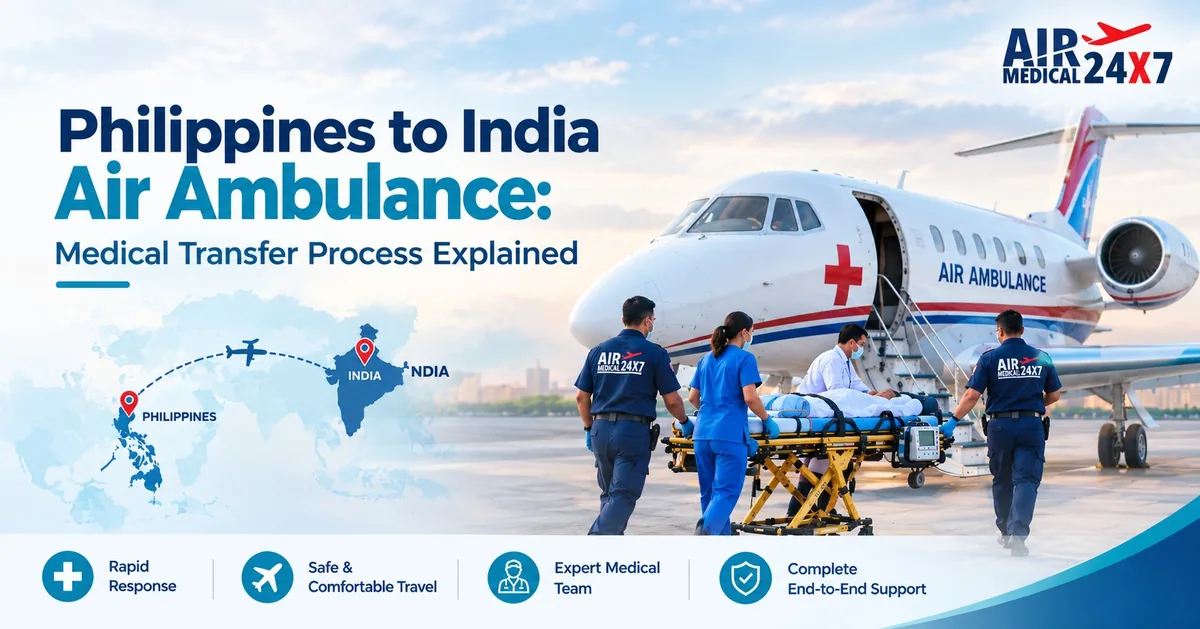
Philippines to India Air Ambulance: Medical Transfer Process Explained
The Philippines hosts a large number of Indian students, many of them studying medicine, along with Indian professionals and travellers. When one of them is seriously injured or falls critically ill, the family in India usually wants them brought home, and often has to organise it from several thousand kilometers away.
This guide explains the Philippines to India air ambulance process, including medical assessment, hospital coordination, flight planning, required documents, and what families need to prepare.
How Does a Philippines to India Medical Transfer Work?
A Philippines to India medical transfer begins with a medical assessment of the patient, followed by selection of a transport option, then confirmation of a receiving hospital in India and preparation of travel and medical documents. Depending on the patient's condition, this may be a dedicated air ambulance, an airline stretcher or a medical escort, with ground ambulances at both ends.
Who Needs a Medical Transfer From Philippines to India?
Medical transfers may be needed after road accidents, serious infections, heart problems, strokes, or other major medical conditions.
Families may also arrange a transfer when the patient needs long-term treatment and wants to continue care in India, closer to family and their usual support network.
Transport Options Over This Distance
| Option | Typically considered for | Practical constraint |
| Dedicated air ambulance | Patients requiring intensive monitoring, advanced medical support, or a level of care that is not suitable for standard commercial travel | Cost, aircraft range and clearances |
| Airline stretcher with escort | Medically stable patients who are unable to travel seated and meet the airline's medical requirements | Airline medical clearance, seat availability, and any connection required |
| Medical escort on a commercial seat | Patients who are medically stable, able to travel seated, and meet the airline's requirements | Limited equipment on board |
Commercial routing between the two countries may involve a connection through a regional hub, which adds a ground transfer between aircraft. Not every patient tolerates that. The Medical Team’s assessment decides which option is suitable. See how doctors decide if a patient is fit to fly.
The Transfer Process, Step by Step
- First contact. Share the patient's name, age, hospital and city, the diagnosis and the Indian city or hospital you have in mind.
- Medical review. Medical Team reads the report and speaks to the treating doctor in the Philippines.
- Receiving hospital. A bed and an accepting consultant are confirmed in India.
- Documents. Travel and medical paperwork is assembled on both sides.
- Aircraft, routing and clearances, where a dedicated aircraft is used.
- Ground ambulances are arranged at both ends.
- Bedside pickup, flight and handover, with the medical team staying with the patient throughout.
Documents for an Indian National Leaving the Philippines
- Valid Indian passport, or an emergency travel document from the Indian Embassy in Manila if the passport is lost or expired
- Medical report and discharge or transfer summary from the Philippine hospital
- Fit-to-fly documentation, or the airline's MEDIF for commercial travel
- Any Philippine immigration formalities that apply to the patient's visa status, such as a student or employment visa
- Consent from the patient or next of kin
- Passport and any required visa for an accompanying relative
Universities and employers can often help with immigration formalities. Where a commercial flight is used, airline medical clearance takes days rather than hours: Philippine Airlines, for example, Airline requirements and charges can change, so the applicable airline should be contacted for the latest requirements.
Routing and Aircraft Considerations
This is a long sector. Aircraft range, the departure airport and the destination city all affect whether a fuel stop is needed. Where a stop is required, the patient normally remains on board with the medical team. Departure is most often from Manila, though transfers can start from Cebu, Davao or another airport depending on the aircraft and the patient's location.
Clearances for the countries along the route, aircraft availability and crew duty limits all shape the schedule, so departure times are confirmed only once these are in place.
Arranging the Receiving Hospital in India
A bed and an accepting consultant have to be confirmed before the flight is scheduled. Families often have a hospital in mind in Delhi NCR, Mumbai, Bengaluru, Chennai, Hyderabad, Kochi or Kolkata. Where there is no preference, the transport provider can approach hospitals with the relevant specialty near the family's home.
If the patient is going to a smaller city, check whether a second leg by road or domestic flight is needed from the arrival airport, and ask what deposit the hospital expects on admission.
Cost Factors
There is no standard price for this route. A quotation depends on the origin and destination cities, distance and routing including fuel stops, the patient's condition and level of care required, aircraft type, medical team composition, equipment and oxygen, ground ambulances at both ends, airport handling and clearances, and urgency.
Check whether the patient holds travel, student or employer insurance. Where an insurer is paying, approval usually has to be obtained before the flight is booked.
How Air Medical 24X7 Supports This Route
Air Medical 24X7 arranges medical transportation between the Philippines and India, including medical assessment, hospital coordination on both sides, and bed-to-bed transfer by air ambulance, airline stretcher or medical escort. Aircraft, route coverage and Indian hospital arrangements.
FAQs
Can the flight go directly from Manila to an Indian city?
It depends on the aircraft's range and the cities involved. Some transfers require a fuel stop, during which the patient stays on board with the medical team.
Can a parent travel with the patient?
On a dedicated aircraft, companion space depends on the configuration and the patient's condition. On commercial flights, relatives can usually book seats on the same flight, and an escort is generally required for stretcher passengers.
What if the student's passport has expired?
The Indian Embassy in Manila may be able to assist with an emergency travel document.. Begin that process early, as it affects the whole timeline.
Can a ventilated patient be moved on this route?
It is assessed case by case. Ventilated patients are normally transferred by dedicated air ambulance with a critical-care team, subject to the flight physician's assessment. See how ICU care continues during flight.
Do we need immigration clearance before leaving the Philippines?
That depends on the patient's visa status. Students and workers may have formalities to complete, and the university or employer can usually assist.
Who arranges the ambulance at the Indian airport?
The transport provider normally arranges ground ambulances at both ends. Confirm this is included in the quotation.
 0
0
0
0
0 Comments
Leave a comment
Get a Quotation in 30 minutes
Categories
Recent Post
Plain Text
Air Medical 24X7 - Worldwide Air Ambulance and Medical Evacuation Services, delivering compassionate and patient-focused care every step of the journey.
Read More