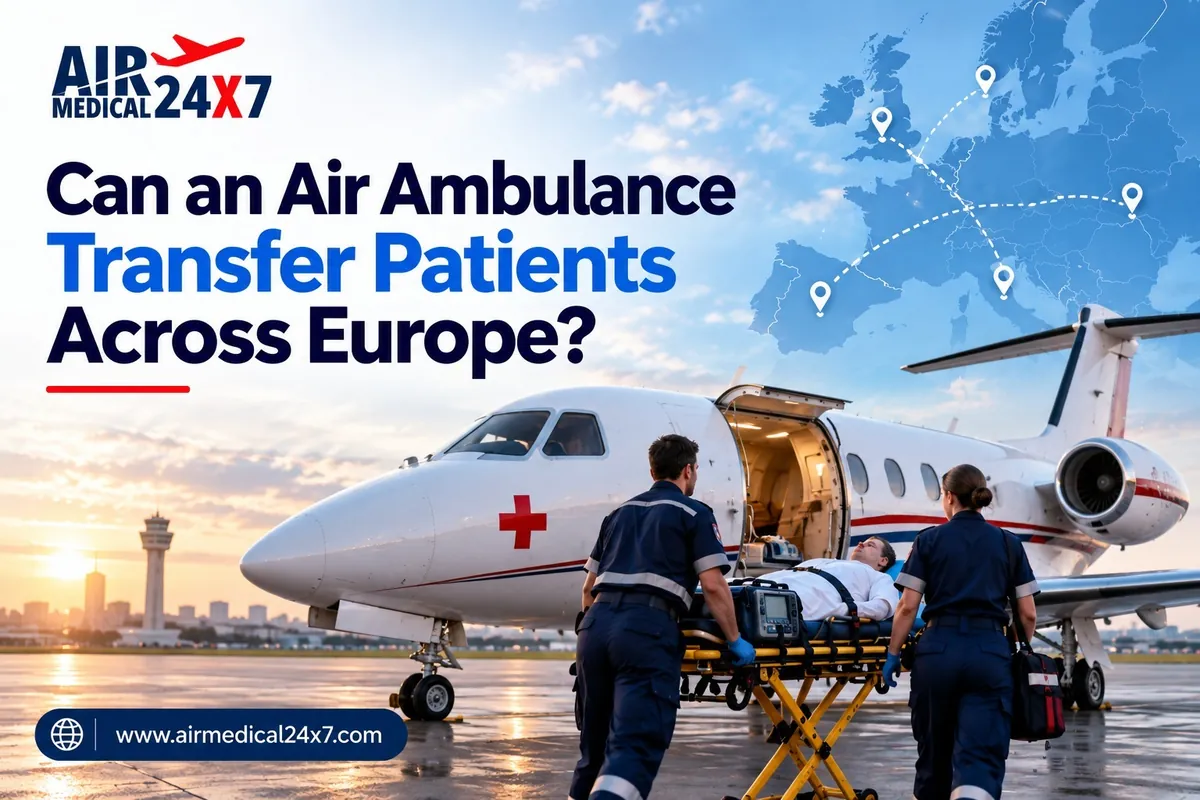
Can an Air Ambulance Transfer Patients Across Europe?
Yes. Air ambulance Europe transfers are commonly used for patients who need to travel between European countries for medical treatment or to return home.
However, a private air ambulance is not always the only option. A patient who is stable and medically fit to fly may be able to travel on a scheduled airline with a medical escort or stretcher. For someone who needs continuous medical support, ventilation or intensive monitoring, a dedicated air ambulance may be more suitable.
The right option depends on the patient's condition, how quickly they need to travel and the level of medical care required during the journey.
What are The Options for Transferring a Patient Across Europe?
There are three main options to consider:
| Option | Usually suitable for | Main consideration |
| Private air ambulance | Unstable patients or those requiring intensive medical support | Greater flexibility and medical support, but usually higher cost |
| Scheduled flight with medical support | Stable patients who are medically fit to fly | Lower cost, but airline approval and planning are required |
| Long-distance road ambulance | Stable patients who can travel safely by road | Takes longer, but avoids airports and air travel |
A private aircraft can be useful when timing is important or when the patient needs medical supervision throughout the journey.
For a stable patient, though, a scheduled flight with a medical escort may be enough. On some routes, a specialist road ambulance can also be a practical alternative.
Can a Patient Travel by Road Between European Countries?
Yes. Long-distance ambulance transfers are used for patients who are stable enough to travel by road but are not suitable for commercial air travel, or when flying would not be the most practical option.
A road transfer can also avoid airport handling, airline medical clearance and multiple transfers.
The downside is simple: it takes longer. Whether that matters depends on the distance and the patient's medical needs.
Does The Schengen Area Make Medical Transfers Easier?
The Schengen Area can make movement between participating countries simpler, but it does not mean that every medical transfer can happen without paperwork.
Eligible travellers can generally move between participating Schengen countries without routine internal border checks. However, an international medical transfer may still require coordination between hospitals, transport providers and other relevant authorities.
Visa and entry requirements can also depend on the patient's nationality and destination.
For that reason, these requirements should be checked before the transfer is arranged.
How long does a European air ambulance transfer take?
The flight itself may be relatively short on many European routes, but the total transfer takes longer than the time spent in the air.
The journey can also involve:
- Ambulance transfer from the hospital
- Medical assessment
- Aircraft preparation
- Airport handling
- Loading the patient
- Coordination with the receiving hospital
- Ambulance transfer after landing
So even when the flying time is only a few hours, the full medical transfer may require considerably more planning.
Who Pays for an Air Ambulance Transfer in Europe?
This is an important question to settle before making arrangements.
A Global Health Insurance Card (GHIC) or European Health Insurance Card (EHIC) can provide access to medically necessary state healthcare under the applicable arrangements. However, GOV.UK states that GHIC and EHIC are not alternatives to travel insurance and do not cover medical repatriation.
Travel insurance may cover medical repatriation where the policy includes it. GOV.UK advises travellers to check their insurance carefully and contact their insurer's assistance service when medical problems arise.
The S2 scheme, a system that can provide funding for planned state healthcare in another eligible European country when the required conditions are met and treatment has been authorised in advance, is different from travel insurance.
NHS Inform explains that the S2 scheme relates to planned healthcare and does not cover travel and accommodation costs. It should not be treated as general cover for medical repatriation.
Where there is no applicable insurance or other funding, the patient, their family, or other personal funds may need to cover the cost of private medical transport.
Which Transport Option is Right for The Patient?
It is better to start with the patient's medical condition rather than the aircraft.
A patient who is ventilated, unstable or dependent on intensive medical support may need a dedicated air ambulance.
Someone who is stable and medically fit to travel may be able to use a scheduled airline with a medical escort or stretcher.
For certain routes, a long-distance road ambulance may be a sensible alternative.
A medical assessment should be carried out before deciding which option is appropriate.
Air Ambulance or Scheduled Commercial Flight?
For stable patients, a commercial airline can sometimes be a practical and more economical option.
The airline may require medical clearance, and arrangements such as a stretcher or medical escort need to be organised in advance.
A private air ambulance offers greater control over the journey and allows the medical team to provide a higher level of support during the flight. This can be important for patients who cannot safely travel on a normal commercial service.
The most suitable option is the one that matches the patient's medical needs.
What Should Families Prepare Before a European Medical Transfer?
Having the patient's medical information ready can make the planning process much smoother.
The transport provider may need:
- Current medical reports
- Diagnosis and treatment history
- Treating doctor's contact details
- Oxygen or ventilation requirements
- Medication and infusion details
- Fitness-to-fly information
- Hospital collection details
- Destination hospital details
- Receiving doctor's contact information
A receiving hospital should also be prepared to accept the patient before the transfer takes place.
Can an Air Ambulance Transfer a Patient to UK?
Yes. Patients can be transferred from European countries like private air ambulance in UK, a scheduled airline with medical support or, where appropriate, road ambulance.
The choice depends on the patient's medical condition, the distance involved and the level of medical support required during the journey.
A stable patient may be able to travel with a medical escort, while a critically ill patient may require a dedicated medical aircraft.
Important Disclaimer
This article is provided for general educational and informational purposes only. It is not medical, financial, insurance or legal advice. Every patient and transfer is different, and the appropriate method of transport should be determined following a suitable medical assessment.
FAQ
Can an air ambulance transfer patients across Europe?
Yes. Private air ambulances are used for international medical transfers between European countries. The type of aircraft and medical team required depends on the patient's condition.
Is a private air ambulance always necessary?
No. Some stable patients can travel on a scheduled airline with a medical escort or stretcher. A long-distance road ambulance may also be suitable for certain journeys.
Does GHIC cover an air ambulance?
No. GOV.UK states that GHIC and EHIC are not alternatives to travel insurance and do not cover medical repatriation.
Does travel insurance cover medical repatriation?
Many travel insurance policies include medical repatriation, but the exact terms, limits and exclusions vary. Travellers should check their policy and contact their insurer's assistance service if a medical emergency occurs abroad.
Does the S2 scheme cover medical repatriation?
The S2 scheme is intended for approved planned healthcare in another eligible European country. It is not general medical repatriation cover, and NHS Inform states that travel and accommodation costs are not covered under the scheme.
How is the right transport method chosen?
The decision should be based on the patient's medical condition, fitness to travel, required level of medical support and the practicalities of the route.
 0
0
0 Comments
Leave a comment
Get a Quotation in 30 minutes
Categories
Recent Post
Plain Text
Air Medical 24X7 - Worldwide Air Ambulance and Medical Evacuation Services, delivering compassionate and patient-focused care every step of the journey.
Read More