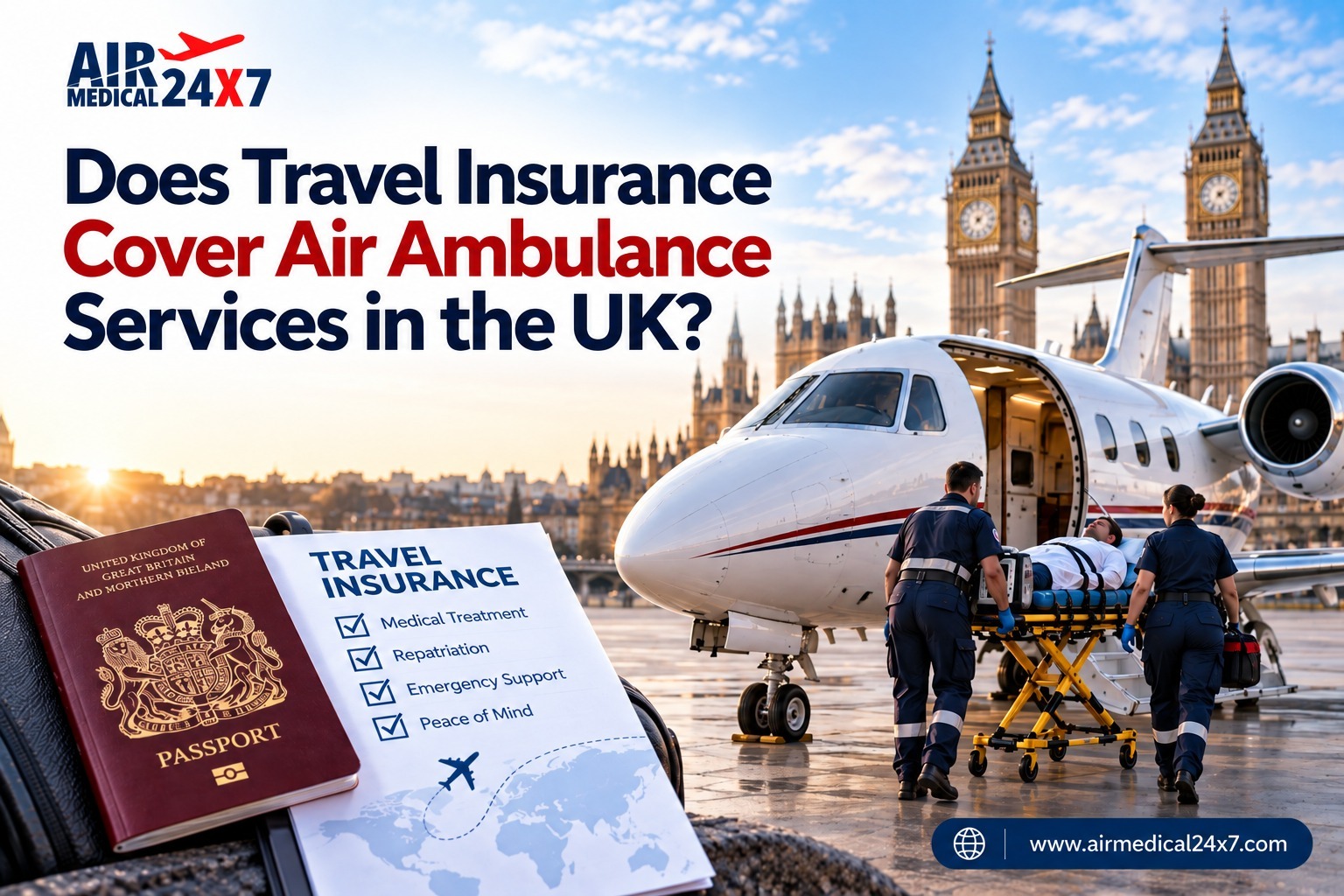
Does Travel Insurance Cover Air Ambulance Services in UK?
If you have a medical emergency in the UK and an air ambulance is needed, you will not be charged for the air ambulance service.
Medical repatriation is a different situation. This is when someone becomes ill or is injured while abroad and needs to return to the UK. Travel insurance may help with the cost of getting them home, but what is covered will depend on the policy, its limits and any exclusions.
That difference is worth understanding. An emergency air ambulance in UK and a private medical repatriation flight from overseas are not the same service.
How Does Travel Insurance Cover Medical Repatriation?
Travel insurance is there to help with unexpected medical problems while you're away. Depending on your cover, this can include emergency treatment abroad and the cost of getting back to the UK when you are not able to use your original travel arrangements.
GOV.UK advises travellers to have suitable travel insurance for medical treatment abroad. Its guidance also recommends checking whether your insurer has a 24-hour assistance helpline, particularly in case you need help arranging treatment or your journey home.
The Financial Ombudsman Service explains that medical expenses and repatriation are generally covered under the medical section of a travel insurance policy. This can include treatment for an illness or injury abroad and the cost of returning the traveller to the UK.
But having travel insurance does not automatically mean that every type of medical transport will be covered.
Things such as the level of medical support you need, the policy limit, exclusions and any requirements to contact the insurer can all make a difference.
Why Can Medical Repatriation Become Expensive?
A serious medical emergency abroad can become expensive very quickly. A patient may need to stay in hospital for several days or weeks before they are well enough to travel. In more serious cases, getting home may also require medical staff, specialist equipment or a dedicated aircraft.
The Association of British Insurers (ABI) reported on 21 August 2025 that its members paid £472 million across more than 500,000 travel insurance claims in 2024.
Medical expenses accounted for £262 million of those claims. The ABI also reported a case where more than £1 million was paid for emergency treatment in the United States followed by repatriation to the UK.
These figures relate to ABI members rather than the entire UK insurance market, but they give a useful indication of how costly a serious medical emergency abroad can become.
When Might Travel Insurance Not Cover Repatriation?
There isn't one rule that applies to every policy. Insurance providers have their own terms and conditions, but some issues appear regularly when repatriation is involved.
1. Pre-existing medical conditions
A health condition you had before travelling can affect your travel insurance.
Some insurers ask travellers to declare existing conditions or complete medical screening before the trip. If a relevant condition was not disclosed, it can become an issue when a claim is made later.
The Financial Ombudsman Service deals with complaints involving pre-existing medical conditions and looks at the policy wording, the information given when the policy was purchased and the circumstances of the individual case.
If you have a medical condition, make sure you understand what your insurer requires before you travel.
2. Your medical cover limit has been reached
Travel insurance does not provide unlimited cover.
A long hospital stay, specialist treatment or major medical procedure can use a significant part of the available cover. By the time the patient is ready to return home, there may be less cover remaining than expected.
Policies also differ in how they structure medical and repatriation limits. Some may have separate limits, while others may deal with them differently.
Check the medical and repatriation sections of your own policy rather than relying on a general assumption about what is covered.
3. The Insurer Considers Another Method of Transport Appropriate
Medical repatriation does not necessarily mean a private air ambulance.
Depending on the patient's medical condition, possible arrangements may include:
- Medical escort on a scheduled airline
- Commercial airline stretcher
- Specialist medical transport
- Private air ambulance
The Financial Ombudsman Service specifically receives complaints about whether someone should have been repatriated, whether repatriation should have happened sooner and whether it should have been carried out differently.
The appropriate transport method depends on the patient's medical condition and available medical evidence.
4. Repatriation is Arranged Without Contacting the Insurer
Many travel insurance policies require the policyholder to contact the insurer or its assistance provider before arranging significant medical treatment or repatriation.
However, it is not accurate to say that every claim automatically fails if the insurer was not contacted first.
The Financial Ombudsman Service considers the individual circumstances, including why the insurer was not contacted and whether the costs were necessary and reasonable.
Where circumstances allow, contact your insurer's emergency assistance team before arranging repatriation.
GOV.UK also advises travellers to contact their insurance company as soon as possible if they become ill abroad and to keep relevant medical records and receipts.
5. Treatment Takes Place at a Private Hospital
Private medical treatment is not automatically covered by every travel insurance policy.
Coverage depends on the policy wording and circumstances.
In an emergency, the traveller may have limited control over which medical facility initially provides treatment, so the circumstances surrounding the treatment can be important when assessing a claim.
6. Travelling Against Foreign, Commonwealth & Development Office Advice
The Foreign, Commonwealth & Development Office (FCDO) publishes travel advice for destinations around the world.
GOV.UK advises travellers to check whether their travel insurance remains valid if they travel to a destination where the FCDO advises against all travel or all but essential travel.
The effect of such advice depends on the individual policy, so travellers should check both their insurance wording and the current FCDO travel advice before travelling.
7. Alcohol or recreational drugs
The Association of British Insurers advises that travellers who are injured after drinking excessively may not be able to claim for emergency medical treatment or other associated costs.
The ABI also states that most standard travel insurance policies contain exclusions relating to recreational drug use.
The exact exclusion depends on the policy and circumstances.
8. Travelling Against Medical Advice
Travel insurance policies may contain exclusions or restrictions relating to travelling when someone has been advised not to travel for medical reasons.
If there is uncertainty about whether a person is medically fit to fly, appropriate medical advice should be obtained before travelling.
Does a Global Health Insurance Card Cover Repatriation?
No.
A Global Health Insurance Card (GHIC) or European Health Insurance Card (EHIC) is not a replacement for travel insurance.
GOV.UK states that GHIC and EHIC do not cover private medical healthcare costs or repatriation.
GOV.UK's guidance on medical emergencies abroad also states that if you are ill abroad and require medical repatriation or evacuation, your insurance company should arrange it where your policy provides cover. If your insurance does not cover the cost, you will have to arrange and pay for it yourself.
The British embassy or consulate cannot arrange or pay for medical repatriation.
What Happens if Your Insurer Refuses a Repatriation Claim?
If your insurer refuses or limits a claim, you should first contact the insurer and follow its formal complaints procedure.
1. Ask for the decision in writing
Ask the insurer to explain:
- Why the claim was refused or limited
- Which policy clause applies
- What evidence was considered
2. Review your policy
Check the relevant medical cover, exclusions, limits and repatriation provisions.
3. Make a formal complaint
If you disagree with the insurer's decision, make a formal complaint directly to the insurer.
4. Financial Ombudsman Service
If the complaint remains unresolved and is eligible, it may be referred to the Financial Ombudsman Service.
The Financial Ombudsman Service provides a free and independent service for eligible complaints about financial businesses, including travel insurance complaints.
Air Medical 24X7 does not assess, manage, submit or advise on insurance claims or insurance disputes.
What Does the Financial Ombudsman Service Consider?
The Financial Ombudsman Service says it receives complaints involving:
- Delays in confirming insurance cover
- Medical treatment
- Whether someone should have been repatriated
- Whether repatriation should have happened sooner
- Whether a different repatriation method should have been used
- Pre-existing medical conditions
The Ombudsman considers the individual circumstances, policy wording and available evidence.
Published FOS case example
The article previously referred to a case where a husband arranged a private aircraft for his wife after contacting the insurer's medical helpline.
The exact source is:
Financial Ombudsman Service, Ombudsman News, Issue 105, September/October 2012, Case Study 105/5 — “Complaint about a medical expenses claim rejected because repatriation ‘had not been necessary’.”
In that case, the couple were on holiday in Tuscany. The husband contacted the insurer's medical helpline, but instead of arranging repatriation, the insurer advised that his wife should be medically assessed locally and that advice was needed on whether she was fit to fly.
The husband subsequently paid £5,000 for a private aircraft to return them to the UK. The insurer rejected the claim.
The Ombudsman did not uphold the complaint, finding that the insurer's position was not unreasonable and that the private repatriation had not been shown to be medically necessary.
Importantly, this was a published case study rather than a current individual decision reference, and the Financial Ombudsman Service itself states that its illustrative case studies are not precedents and that individual cases are decided on their own facts.
When Might Private Medical Repatriation Be Required?
Private medical repatriation may need to be considered when:
- There is no travel insurance
- The policy does not provide relevant cover
- The applicable insurance limit has been exhausted
- The required transport is not covered
- The circumstances fall outside the insurance policy
Depending on the patient's condition, transport options may include:
Medical escort → Airline stretcher → Private air ambulance → Specialist critical-care transfer
The appropriate option depends on the patient's clinical condition, fitness to fly, medical equipment, clinical team and receiving hospital.
Important Disclaimer
This article is provided for general educational and informational purposes only. It does not constitute medical, financial, insurance or legal advice and does not determine whether any particular insurance policy covers a claim.
Travel insurance policies differ between providers. Always check your individual policy wording, exclusions, limits and assistance requirements.
Air Medical 24X7 does not assess, manage, submit or provide advice on insurance claims or insurance disputes.
FAQ
Does travel insurance cover air ambulance services?
Travel insurance may cover medical repatriation, including appropriate medical transport, depending on the policy terms and circumstances. Check your policy and contact the insurer's assistance team.
Can I arrange my own air ambulance and claim the cost back?
Do not assume that you will automatically be reimbursed. Where circumstances allow, contact your insurer or emergency assistance provider before arranging significant medical transport.
Does a GHIC cover medical repatriation?
No. GOV.UK states that a Global Health Insurance Card and European Health Insurance Card do not cover medical repatriation.
What if my insurer refuses my claim?
Ask the insurer for its decision and reasons in writing and follow its formal complaints process. Where eligible, the complaint can subsequently be referred to the Financial Ombudsman Service.
Can AirMedical 24X7 help with my insurance claim?
No. AirMedical 24X7 does not assess, manage, submit or provide advice on insurance claims or insurance disputes.
 0
0
0 Comments
Leave a comment
Get a Quotation in 30 minutes
Categories
Recent Post
Plain Text
Air Medical 24X7 - Worldwide Air Ambulance and Medical Evacuation Services, delivering compassionate and patient-focused care every step of the journey.
Read More