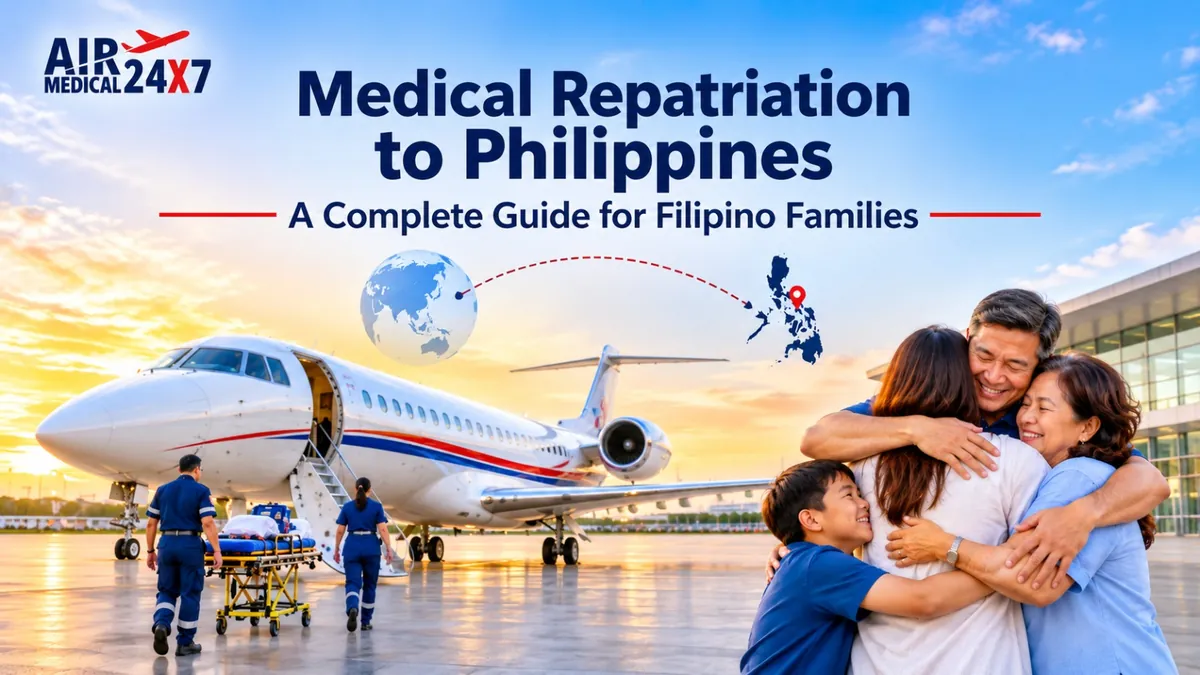
Medical Repatriation to Philippines: A Complete Guide for Filipino Families
Medical repatriation to the Philippines means bringing a sick or injured Filipino home from abroad with the medical support the journey requires. The relative may be a worker in the Gulf, a seafarer taken ashore at a foreign port, a migrant in Europe or North America, or a family member who fell ill while travelling.
This guide is written for the people at home, who usually have to make decisions with incomplete information and from a long way away.
What Does Medical Repatriation Involve?
Medical repatriation involves a medical assessment of the patient abroad, confirmation of a receiving hospital in the Philippines, preparation of travel and medical documents, and transport with medical support. Depending on the patient's condition, that may be a medical escort, an airline stretcher or a dedicated air ambulance, with ground ambulances at both ends.
The First 24 Hours
Write things down as you learn them. Try to establish the hospital name and city, the treating doctor's name and contact details, what happened and the diagnosis as the hospital describes it, whether your relative is conscious and able to speak, and who else already knows, including the employer, agency or manning company.
Then contact the Philippine embassy or consulate in that country. Consular staff may be able to provide information, help contact the employer, and provide consular assistance.
Deciding When to Bring Them Home
Families want their relatives home immediately. The medical team has to weigh that against the journey itself. The flight physician considers whether the condition is stable, whether flying could make it worse, what treatment is still needed and how long the journey is, including connections.
Sometimes the advice is to wait a few days until your relative is stronger. That is difficult to hear, and it is usually the safer answer. Our article on how doctors decide if a patient is fit to fly explains the reasoning.
Choosing How They Travel
| If your relative | Typically considered |
| Can sit upright and manage a seat | Medical escort on a commercial flight |
| Must lie flat but is stable | Airline stretcher with an escort |
| Is in intensive care, ventilated or unstable | Dedicated air ambulance |
| Needs to move urgently | Dedicated air ambulance |
Airline stretcher travel depends on the carrier's medical clearance and advance notice. Philippine Airlines, for example, requires a MEDIF completed by the attending physician five to seven days before travel, a stretcher request at least 48 hours ahead and an able-bodied escort. Other airlines set their own conditions. See our comparison of airline stretcher services and dedicated air ambulance transport.
Choosing The Receiving Hospital
This is the family's decision, guided by the medical requirement. Consider:
- The clinical need. A stroke patient may need neurology and rehabilitation services. A burns patient needs a burns unit.
- Distance from family. Recovery is easier when relatives can visit. For families in the Visayas or Mindanao, Cebu or Davao may suit better than Manila.
- Cost and PhilHealth. Ask which benefits apply and what deposit the hospital expects on admission.
- Bed availability. The hospital must review the case and confirm a bed before the flight is scheduled.
Documents to Collect
- Your relative's passport, which employers sometimes hold.
- Medical reports and a discharge or transfer summary from the hospital abroad.
- Fit-to-fly documentation, or the airline's MEDIF for commercial travel.
- Exit clearance, where the host country requires one.
- Proof that hospital bills abroad are settled or guaranteed.
- Written acceptance from the receiving hospital.
- Authorisation signed by your relative or, if they cannot sign, the next of kin.
If your relative cannot sign, ask the embassy how to complete an authorization from the Philippines.
Who Pays
Funding often comes from more than one source, and none of them should be assumed:
- The employer, under the employment contract.
- The recruitment or manning agency.
- Travel, health or employer-provided insurance, usually with prior approval.
- OWWA support for eligible members, where the patient is an OFW.
- The family, sometimes with help from the local government unit.
Ask each party in writing what they will cover. For OFW cases specifically, read our guide on medical repatriation for OFWs.
Costs themselves depend on the origin and destination, the patient's condition and level of care, the transport option, aircraft type where one is chartered, medical team and equipment, ground ambulances at both ends, airport charges and clearances, and urgency. Ask for an itemised written quotation.
Seafarers
Seafarers are usually covered by their employment contract and the manning agency's insurance, which commonly handle medical repatriation. Contact the manning agency first and ask for the case reference before arranging anything independently.
Preparing for Arrival
Before the flight departs, confirm the arrival airport and the ground ambulance meeting the aircraft, decide who from the family will be at the hospital, and gather your relative's PhilHealth details and identification. Plan past the hospital stay too: rehabilitation, home nursing, and equipment such as a wheelchair or hospital bed take time to organize.
Share the work. One relative handles the hospital abroad, one the employer or agency, one the transport provider. Keep a shared note of names, numbers and what each person said.
How Air Medical 24X7 Supports Families
Air Medical 24X7 coordinates medical transportation for patients returning to the Philippines, including medical assessment, coordination with the hospital abroad and the receiving hospital, ground ambulance arrangements and bed-to-bed transfer. Coverage, aircraft and hospital coordination details:
FAQs
How long does medical repatriation to the Philippines take? It depends on the patient's condition, documentation, hospital acceptance and the transport option. Airline stretcher cases need days of lead time for medical clearance. Dedicated aircraft transfers are planned case by case.
Can I travel abroad to accompany my relative home? Yes, if you can travel in time and hold the required visa. On commercial flights you can book a seat on the same aircraft. On a dedicated aircraft, companion space depends on the configuration.
What if my relative's passport is missing or expired? The Philippine embassy or consulate can issue a travel document. Start that process early, because it affects the whole timeline.
Will PhilHealth cover treatment after arrival? PhilHealth benefits apply to eligible members at accredited hospitals. Confirm the specifics with the hospital and PhilHealth.
Can my relative be flown to a provincial hospital instead of Manila? Often yes, depending on the airport and the receiving hospital. Arriving in Cebu or Davao can shorten ground travel for families in the Visayas or Mindanao.
Who arranges the ambulance at the arrival airport? The transport provider normally does. Confirm it is included in the quotation, since ground transport is a common exclusion.
 0
0
0 Comments
Leave a comment
Get a Quotation in 30 minutes
Categories
Recent Post
Plain Text
Air Medical 24X7 - Worldwide Air Ambulance and Medical Evacuation Services, delivering compassionate and patient-focused care every step of the journey.
Read More